
Picking which Polish cities deserve your limited vacation days gets confusing fast — every list online repeats the same five names without explaining why one city takes two hours and another needs four days. Poland’s most interesting cities range from a completely rebuilt medieval capital to a Baltic port with sand dunes on its doorstep, and knowing the difference saves you from wasting a trip on the wrong itinerary. Below is what actually sets each city apart, how much time it realistically needs, and which ones pair well together on a single route.
Kraków: the city that survived intact
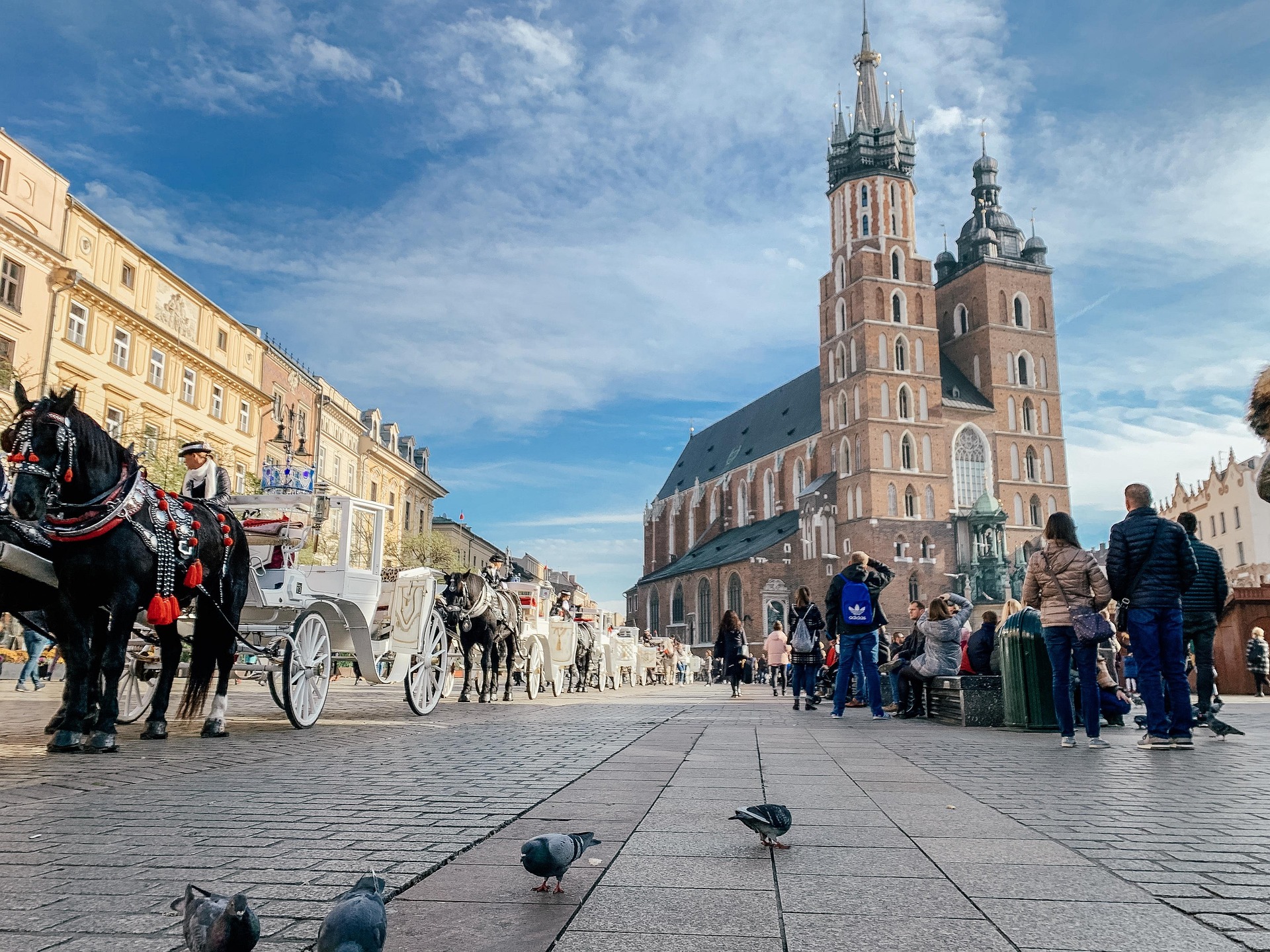
Kraków is the one major Polish city the Second World War left largely untouched, which is why its Old Town — Rynek Główny, one of the largest medieval market squares in Europe at roughly 200 by 200 meters — still has original 13th-century foundations under Renaissance and Gothic facades. Wawel Castle and Cathedral sit on a hill above the river, and the former royal capital (Kraków held that title until 1596) still feels like one. Budget at least two full days: one for the Old Town and Wawel, one for Kazimierz, the historic Jewish district, and a half-day extra if you’re adding Auschwitz-Birkenau, 70 km west.
Warsaw: rebuilt from ruins
Warsaw’s Old Town looks medieval but isn’t — 85% of it was destroyed in 1944 and rebuilt brick by brick after the war, a reconstruction precise enough that UNESCO listed it as a World Heritage Site in 1980. What makes the capital worth a dedicated stop isn’t just the Old Town but the contrast next to it: the Palace of Culture and Science, a 231-meter Stalinist-era skyscraper, stands a short walk from POLIN, a museum covering a thousand years of Jewish history in Poland. Two days is the minimum to cover both without rushing.
Gdańsk and the Tri-City
Gdańsk combines Hanseatic League architecture — the colorful merchant townhouses along Długi Targ — with recent political history: the Solidarity movement started here at the Gdańsk Shipyard in 1980, and the European Solidarity Centre museum documents it in detail. Paired with neighboring Sopot, home to Europe’s longest wooden pier at 511 meters, and Gdynia’s modernist interwar architecture, the Tri-City covers beach, history, and nightlife in roughly 30 km of coastline.
Gdańsk’s amber trade dates back over 3,000 years — the city still produces an estimated 80% of the world’s processed Baltic amber jewelry.
Wrocław: bridges and dwarfs
Wrocław sits on the Oder River across 12 islands connected by more than 100 bridges, earning comparisons to Venice or Amsterdam that are exaggerated but not baseless. The city’s other signature feature is stranger: over 600 small bronze dwarf statues (krasnale) scattered across the streets, a project that started in 1988 as a tribute to an anti-communist resistance movement and became a genuine tourist hunt. The rebuilt Market Square and the Centennial Hall, a UNESCO-listed 1913 reinforced-concrete structure, round out a solid one-to-two-day stop.
Poznań: the overlooked business hub
Poznań rarely makes top-five lists, which is a mistake given its Old Town Market Square and the Croissant Museum built around Poznań’s official pastry, the rogal świętomarciński — a crescent-shaped roll with white poppy-seed filling protected under EU regional status since 2008. The city’s Ostrów Tumski cathedral island claims to hold the tombs of Poland’s first rulers, Mieszko I and Bolesław Chrobry, making it arguably the birthplace of the Polish state. One day is enough for the center.
Łódź: the industrial alternative
Łódź built its identity on 19th-century textile factories, and the best of them — the former Poznański factory complex — is now Manufaktura, a shopping and culture complex that kept the red-brick industrial shell. Piotrkowska Street, at 4.2 km one of the longest commercial streets in Europe, runs straight through the center lined with cafés, murals, and Art Nouveau townhouses. It’s a strong add-on if you’re already routing between Warsaw and Wrocław, rather than a standalone destination.
Comparing the cities
| City | Main draw | Time needed | Best paired with |
|---|---|---|---|
| Kraków | Intact medieval Old Town, Wawel | 2 days | Auschwitz, Zakopane |
| Warsaw | Rebuilt Old Town, POLIN | 2 days | Łódź |
| Gdańsk | Hanseatic architecture, Solidarity history | 2 days | Sopot, Gdynia |
| Wrocław | Islands, bridges, dwarf statues | 1-2 days | Poznań |
| Poznań | Old Town Market, Ostrów Tumski | 1 day | Wrocław |
| Łódź | Manufaktura, Piotrkowska Street | 1 day | Warsaw |
Building a route
Kraków and Warsaw don’t need to compete for the same trip slot — they’re 300 km apart and connected by express trains that take under three hours, making a Warsaw-Łódź-Wrocław-Kraków loop realistic in seven to eight days. The Tri-City sits far enough north that it works best as a separate coastal trip, either on its own or tacked onto Gdańsk with a few extra days for the beaches in Sopot. Trains are the practical choice throughout Poland; PKP Intercity connects all six cities directly, and tickets booked a few weeks ahead typically run well under 100 PLN even for the longer routes.
Frequently Asked Questions
Which Polish city should you visit first?
Kraków is the standard first stop — its Old Town survived the war intact, so it gives the clearest sense of pre-war Polish architecture without needing context about reconstruction.
Is Warsaw worth visiting if Kraków looks more historic?
Yes — Warsaw’s value is the contrast between its rebuilt Old Town and its 20th-century layers, from the Palace of Culture to POLIN, which Kraków doesn’t offer.
How many Polish cities can you realistically see in one week?
Three to four with a train-based route — for example Warsaw, Łódź, Wrocław, and Kraków — without spending entire days in transit.
Is Gdańsk worth a separate trip from the rest of Poland?
Generally yes, since it sits far north on the coast; combining it with Sopot and Gdynia makes more sense than squeezing it into a southern-Poland itinerary.
What’s the cheapest way to travel between these cities?
PKP Intercity trains connect all six directly, and advance-purchase tickets usually cost under 100 PLN even for longer routes like Gdańsk to Kraków.
Source: exploris.pl