
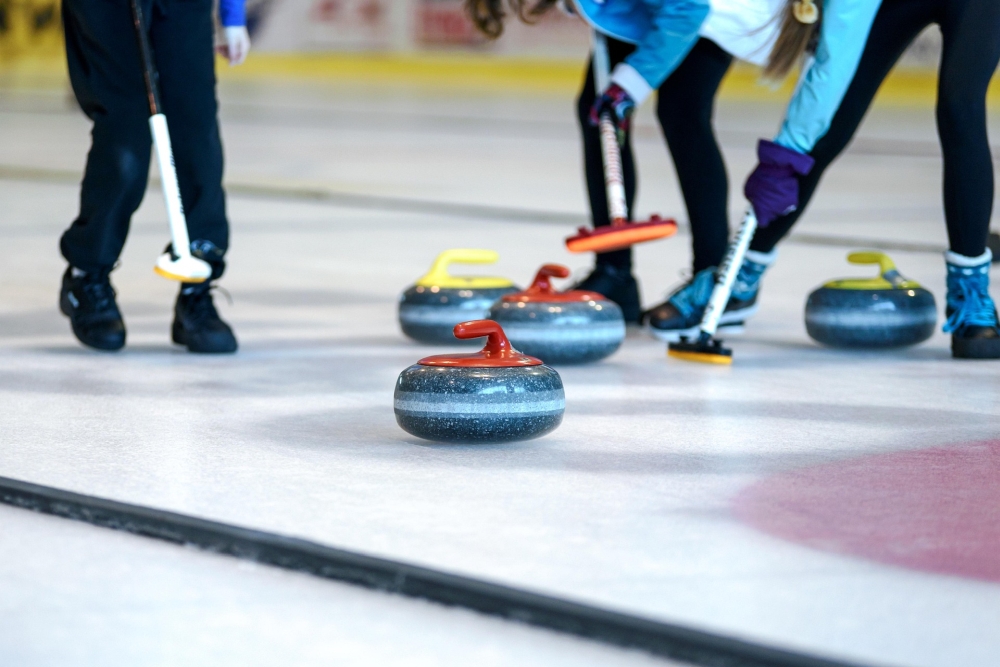
Someone unfamiliar with winter sports watching curling for the first time usually asks the same question: why are grown adults sweeping a stone across ice with brooms, and why does this count as an Olympic sport? Fair question — and curling isn’t even the strangest example. The world’s strangest sports range from genuinely competitive disciplines with international federations and world championships to events that started as pub jokes and somehow never stopped. Here’s a tour through the odder end of organized sport, including several that made it all the way to Olympic legitimacy.
Curling: chess on ice, and an actual Olympic sport
Curling is the clearest example of a sport that looks absurd to outsiders but is taken with total seriousness by its competitors. Two teams slide 19-kilogram granite stones across a sheet of ice toward a target, while teammates sweep the ice furiously in front of the stone to control its speed and curve. It’s been a full Winter Olympic medal sport since the 1998 Nagano Games (with a one-off demonstration appearance as far back as 1924), and Scotland is widely credited as its birthplace, with matches recorded on frozen lochs dating back to the 16th century. Despite its slow pace, curling demands genuine strategic depth — commentators regularly compare it to chess, since a single well-placed stone can block or set up plays several turns in advance.
Curling stones are cut almost exclusively from a single quarry — Ailsa Craig, a small granite island off the coast of Scotland — because the rock there is unusually dense and water-resistant, making it ideal for withstanding repeated ice impacts without cracking.
Chess boxing: exactly what it sounds like
Chess boxing alternates rounds of competitive chess with rounds of actual boxing, and a competitor can win either by checkmate, by knockout, or if their opponent runs out of time on the chess clock. The sport was formalized in the early 2000s, inspired by a French comic book, and now has an active international federation running tournaments across Europe and Asia. What makes it genuinely demanding rather than gimmicky is the physiological whiplash it requires — competitors have to calm an elevated heart rate from a boxing round quickly enough to think clearly through complex chess positions minutes later, a combination of cardiovascular fitness and mental composure that neither sport alone fully tests.
Extreme ironing: literally what it sounds like
Extreme ironing started in England in 1997 as a joke — a man reportedly decided ironing a shirt would be more interesting done outdoors, on a rock face, mid-climb — and it somehow developed into an organized activity with a loose international following. Participants iron clothes in deliberately impractical or dangerous locations: cliff faces, underwater, while skydiving, or on mountain summits, and the “sport” even held an informal World Championship in Germany in 2002. It’s less a competitive discipline with judged scoring and more a shared absurdist hobby, but it’s a genuine example of how far a sport concept can drift from any practical origin and still develop a dedicated community.
Cheese rolling: a 200-year-old event with regular injuries
At Cooper’s Hill in Gloucestershire, England, competitors chase a 3.5-kilogram wheel of Double Gloucester cheese down a steep, uneven hill, with the first person to cross the finish line — assuming they haven’t rolled, tumbled, or been knocked unconscious along the way — winning the cheese itself. The event dates back at least to the early 19th century and possibly much further, and injuries are common enough that ambulance crews are a standing fixture at the annual race. Unlike most entries on this list, cheese rolling has genuinely resisted formalization — there’s no official governing body, and the event has occasionally been officially “cancelled” by local authorities over safety and crowd-size concerns, only for informal, unofficial races to happen anyway.
Wife carrying: a Finnish tradition with an unusual prize
Wife-carrying racing (Eukonkanto) originated in Finland and involves a competitor carrying a partner — traditionally a spouse, though rules have loosened to allow any partner over a minimum weight — through an obstacle course including a water hazard, with the fastest team winning. The event traces back to 19th-century Finnish folklore involving wife-stealing raids, though the modern competitive version dates to 1992. The prize at the official World Championship in Sonkajärvi has, at various points, been the winning wife’s weight in beer, a detail that gets repeated in nearly every write-up of the sport for obvious reasons.
Comparing formalization level across strange sports
| Sport | Origin | Formal status |
|---|---|---|
| Curling | Scotland, 16th century | Winter Olympic sport since 1998 |
| Chess boxing | Inspired by 1990s comic, formalized 2003 | International federation, world tournaments |
| Sepak takraw | Southeast Asia, centuries old | Asian Games sport, world championships |
| Wife carrying | Finland, folklore-based | Annual World Championship since 1992 |
| Cheese rolling | England, 19th century or earlier | No official governing body |
| Extreme ironing | England, 1997 (as a joke) | Loose informal community, no strict judging |
Sepak takraw: volleyball played almost entirely with the feet
Sepak takraw, popular across Malaysia, Thailand, and the wider Southeast Asian region, looks like volleyball but bans the use of hands entirely — players use only their feet, knees, chest, and head to keep a small rattan or synthetic ball airborne and send it over a net. The acrobatics involved are genuinely elite-level athletic feats: players routinely execute full backflip kicks to spike the ball, a move that would be a highlight-reel moment in almost any other sport and is simply standard technique here. It’s contested at the Asian Games and has its own world championship circuit, making it one of the more institutionally serious entries on this list despite looking, to newcomers, almost impossible to execute without hands.
Bossaball: volleyball, football, and gymnastics on a trampoline
A genuinely modern invention, Bossaball was created in Spain in the early 2000s, combining volleyball rules with football-style kicks, gymnastics, and capoeira-inspired movement, played on an inflatable court that includes built-in trampolines on each side of the net. It’s grown a small but dedicated international following, with matches often played to live drumming to match its Brazilian-inspired name and rhythm-driven style — a rare example of a “strange sport” invented deliberately as entertainment rather than evolving organically from local tradition or an inside joke.
Why some of these become Olympic sports and others never do
The dividing line generally comes down to three factors: a standardized, judgeable rule set that produces consistent, fair outcomes; sufficient international spread across multiple countries and continents; and a governing federation capable of running anti-doping and officiating programs to Olympic standard. Curling and sepak takraw both cleared that bar — curling through the International Olympic Committee’s recognition process, sepak takraw through Asian Games inclusion and a mature international federation. Cheese rolling and extreme ironing, by contrast, remain deliberately informal by nature; their appeal is tied to local tradition or absurdist humor in a way that resists — and arguably would be diminished by — the kind of standardization Olympic status requires.
For readers who want to follow both mainstream and offbeat sporting events more closely, including coverage of competitions and disciplines beyond what’s covered here, sportowa.com.pl covers a broad range of sports news and events.
Frequently Asked Questions
Is curling actually a difficult sport, or is it as easy as it looks?
It’s genuinely demanding — competitors need precise physical technique to deliver the stone accurately, combined with deep strategic planning several shots ahead, which is why commentators frequently compare it to chess despite its slow, deliberate pace.
Is chess boxing a real competitive sport with rankings?
Yes — it has an active international federation, regular tournaments across Europe and Asia, and formal rules where a match can be won by checkmate, knockout, or if a competitor exceeds their allotted chess clock time.
Why hasn’t cheese rolling become an official Olympic or internationally sanctioned sport?
Its appeal is closely tied to local British tradition and its deliberately chaotic, unregulated nature — attempts at formal standardization or an official governing body would likely undermine exactly what makes the event distinctive, and safety concerns have already led local authorities to cancel official versions at times.
What sport combines volleyball with trampolines?
Bossaball, invented in Spain in the early 2000s, is played on an inflatable court with built-in trampolines on each side of the net, blending volleyball, football-style kicks, and gymnastics-inspired movement.
Which strange sports are actually recognized at major international games?
Curling has been a full Winter Olympic medal sport since 1998, and sepak takraw is contested at the Asian Games with its own world championship circuit — both have mature international federations that meet the standardization required for major multi-sport events.